Showing posts with label Patterns. Show all posts
Monday, March 24, 2014
Friday, February 21, 2014
Reflection on Pin Up
1.
Reflect on the pin-up for
this week: Post all the images / models included in your pin up. Layout your
images as in the pin up.
I think the most successful part
of the pin up was how straightforward my idea was. The fact that is was simple
and clear, it made it easy for people to understand, even though my actual
presentation did not go as smoothly. I liked the positive reaction from
Professor Fraser and I will keep in mind to keep future projects just as
straightforward. I thought a failure in my part was the actual model. Models
are great representations of work, but I kind of botched it up by scaling it
wrong. My model ended up smaller than I expected. The 3D Virtual Casting did
not show all the information I wanted, which I can improve in the future by
creating better diagrams.
2.
Reflect on your
presentation: How did you structure it? How successful do you think it was?
What was your overarching focus? How was it received? What kind of feedback did
you receive? List one of the best questions or comments you received or that
someone else received.
I structured it in the steps that
I performed in the actual work. Such that the synthetic axons belonged in one
set, while the 3D Virtual Casting were in their own set. We first presented the
body diagrams, then the synthetic drawing set, and finally the 3D Virtual
Casting set. I thought this was clear because it was exactly how I transitioned
in between work.
3.
What are your next steps
based on your feedback and your new assignment? What new discoveries have you
made in your work?
My next step would be to think
through my analysis for my next project. I have discovered that I like
exploring enclosures. I think that will be a nice idea to thrive from for
assignment 3.2. I have also learned that forms of analysis is not only forms of
discoveries that we make as individuals, but also an interpretation that we
must try to have others understand.
Monday, February 17, 2014
Journal Entry: #2
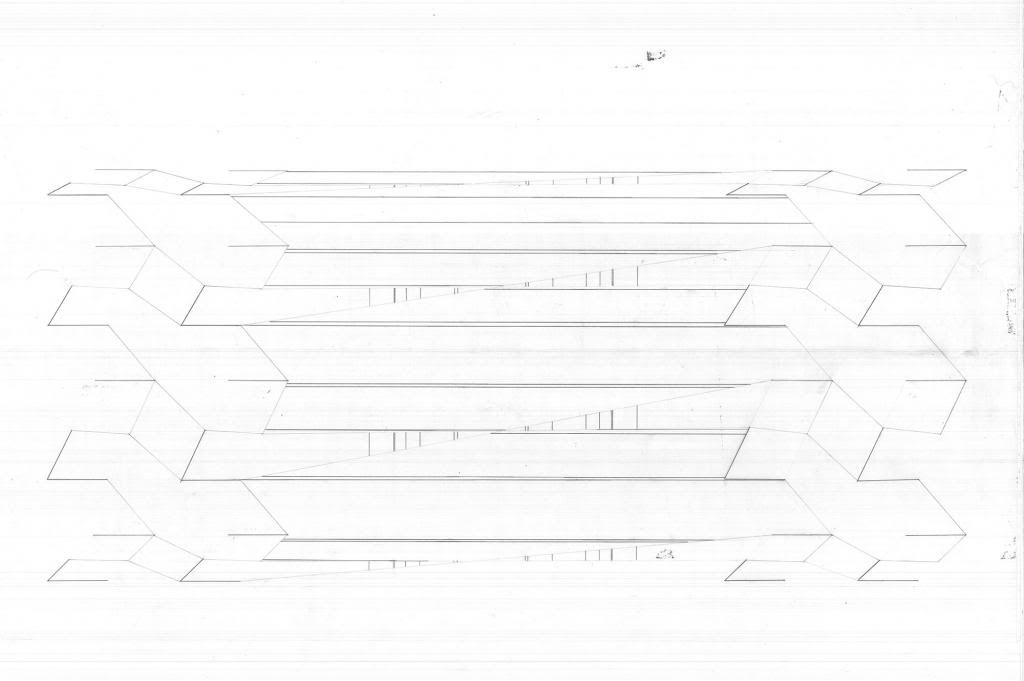
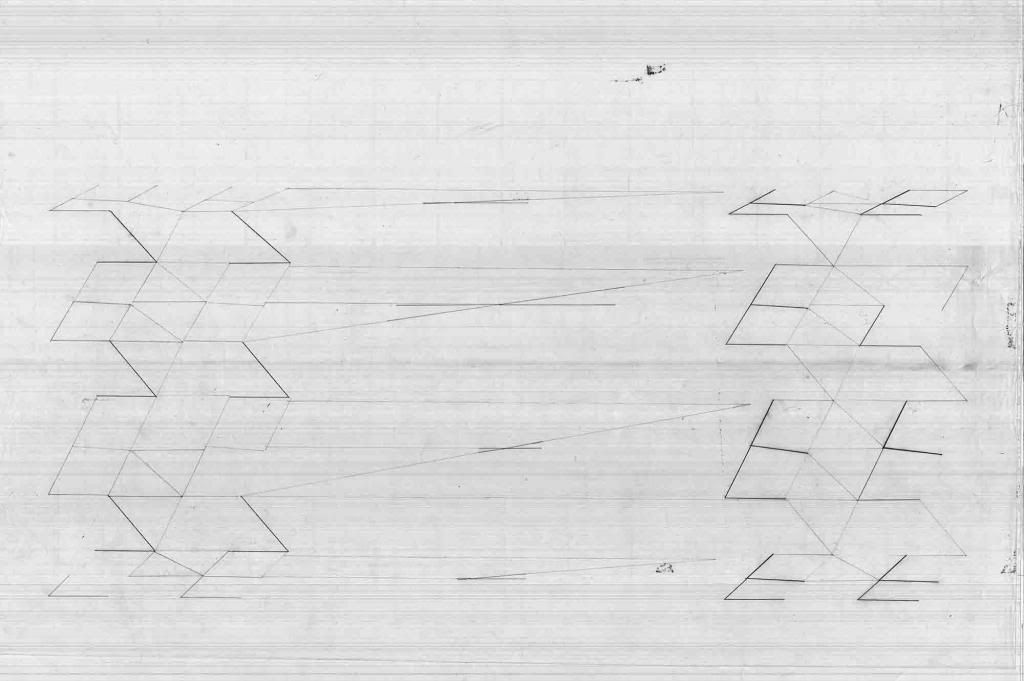
In the
process of creating the 3D version of of my synthetic design combined with the
townhouse elevation, I kept the same theme of using each opening as my
boundary. From there, I drew lines from each frame across to the opposite end.
I then placed my synthetic drawing on each side of the elevation and connected
it. One set was laced closer to the top and the other was at the bottom. This
created a slanted connection between the two mirroring planes. This was done
because of the placement of windows and doors in the house were asymmetrical.
The synthetic design was placed closer to where the windows and doors existing.
Whatever exists more in mass or form prevails, which would mean that the set of
windows on the left hand side would be closer to the synthetic set, while the
the bottom portion would not be placed near a synthetic. The dynamic between
the two synthetics were much like the idea of boundaries in that it was created
by the frames of the window and the doors. This created two sets of direction: a
horizontal and vertical force. The two sets of direction in turn creates this
set of 3D Axon.
The curves in this model is
entirely based off of the flat planes that created a surface, but did not
complete into one whole solid. By creating the curve in the structure, there is
a base point from where the original curved plane comes from. This allows for
its existence. All solids are formed because it is surrounded by other planes.
Once a plane has four or more sides, it is completely enclosed to form one
solid.
Friday, February 14, 2014
Sunday, February 9, 2014
Journal Entry : #1
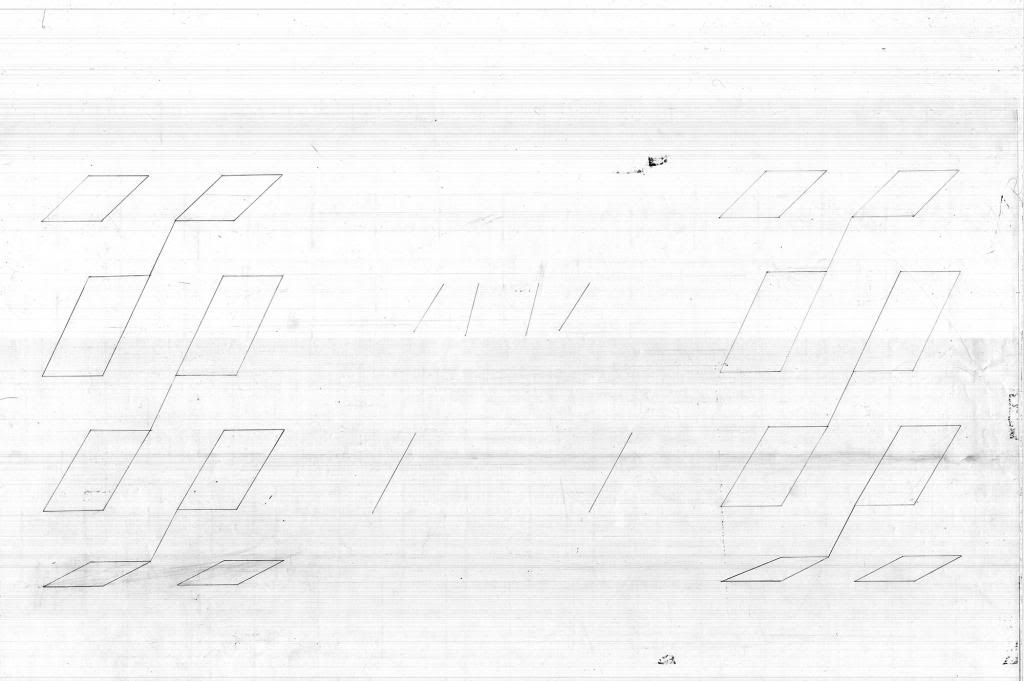
I believe the most
significant moment of transformation occurred shortly after the inclusion of
diagonal lines in the synthetic drawing set. The direct result of this was the
formation of new geometrical shapes. Entirely unexpected, I had started from
something that was more linear in the 90-degree and 180-degree spectrum and
ended up with something with a sense of ordered playfulness. As this new diagonal
element was introduced into my project, I exploited it and created new shapes.
Although, I am not fond of the final outcome, I do find it intriguing that such
a design can result from the combination of 90 and 180-degree lines with several
diagonal lines.
In the translation
process from 2D to 3D, I chose my 5th layer, as I did not like the
result of my final layer. I decided on the 5th layer, because it displayed
more of the process than my final layer. Through this layer, I had chosen
several lines to outline in bold. Due to this decision, I created an
interesting 3D effect on the 2D drawing. Although this is not shown too well on
my rhino drawing, I like the effect that it has on paper and will further include
it in my future design. I like the idea of how hierarchy can play a role in the
creation of different space.
Monday, February 3, 2014
Rule Sets from Various Artists
Anthony Mccall and his Line Describing a Cone has an interesting system. A beam of light is emitted out of a film projector at one end of a dark room. Projecting on the screen is an animated film of a small thin arching line that creates one complete circle as it traces the outline of the circumference of a circle. Viewers are told to stand in front of this interactive art. As the viewer’s body blocks the light, the circle that appears on the screen appear to be either a concave or convex. I think interesting about this system is that it is interactive. In a sense that the outcome is created by different situations, yet the rules are the same. I chose this piece because its something simple yet thought provoking. It’s not something that people would think of as a rule, but it is at the same time.
In Richard Serra’s Gagosian Gallery, the art piece Cycle draws upon a different kind of system from many other artists. Serra is known for his minimalist work and in the Cycle, it’s obvious that it is a very minimalistic piece. Although there is not much to the art piece, it is obvious what Serra is trying to convey. In the swirls that he creates, he has each swirl facing the next swirl. This creates a pinwheel effect, in which the art piece seems to be swirling in one direction. This effect is emphasized by the second ring of swirls around the first set of swirls. This site-specific art acts as spatial division, as well as circulation dictation. This is also the very reason why I chose this piece. The rules for this art piece forces the viewers to act in one direction in unison with the art piece itself.
Oskar Schlemmer’s piece the drawing of a Man as Dancer, really depicts rules in a conventional way that is graceful and interesting. In the center of the art piece, there is a man in a dancing pose. In the center of his chest, circles emit out from his chest. They echo out of the page. Although, a simplistic design, the best part of the piece are the ovals that cast out from the man. An example of this would be the oval over his head connecting to his two hands. This oval overlaps with the ovals that are created from his legs. In this manner, Schlemmer continues to use this man’s body parts as extensions for the ovals. All the ovals overlap, it creates a different art piece with flow and movement in an elegant matter. I thought the rules for this piece was interesting because it is created from such simple decisions, yet it becomes so much of the whole of the art piece.
Source: http://images.artnet.com/artwork_images_168878_633101_anthony-mccall.jpg
Source: http://www.m-kos.net/wp-content/uploads/SERRA_2011_Cycle2_580.jpg
Source: http://media.tumblr.com/tumblr_mez9bfOaSl1qmktfq.png
Subscribe to:
Posts (Atom)