Monday, April 21, 2014

Concept Outline

My concept is based on the idea of overlapping the thresholds between private and public spaces. My story involves two twin brothers that live together. Although, they are twins, they have clashing personalities. While one brother is outgoing and has many friends, the other brother is shy and quieter in comparison. Instead of creating individual separate structures, this structure caters to the need of both brothers.

The spatial quality of each level determines the amount of occupancy, which incidentally determines which brother will reside on which level.
The conservative brother likes to reside in the smaller and intimate spaces. He is more grounded and enjoys quiet activities like reading, meditating, and watching movies with his best friend.

The outgoing brother has a lot of friends and enjoys the company of many. He enjoys the company of many, therefore he needs spaces that allow for many occupants at one time. He enjoys activities that enjoy larger groups of people like dance parties and dinner parties.

The spaces that are directed for the outgoing brother is more open with a sense of fluidity that allows for easy transition between the two larger spaces in the structure.

The spaces directed to the younger brother are more enclosed. It becomes a protective shell. 

Monday, April 7, 2014

Notes on Program

what where when how?


Who: Twin brothers that are living together. Although, they are living together they have clashing personalities.

  • older is careful. responsible. he does everything slowly
  • younger is reckless. likes to multitask. Short attention span


what body movements

  • body movement a is (general theme) slow
  • body movement b is (general theme) fast


Spaces catered to each individual

spaces that need fast easy movement. has to be fluid.

other is more blocky? more universal? why would it be universal?

what makes a space good for this?

what's the shape of the program?

levels. equal but not (Because they are twins)

- interlapping space

-  think about the transitioning spaces. how do they get from one place to another


when do they do things? what activities?

boyish activities?. sports. SINGULAR ACTIVITIES videogames. reading. enclosed. small. tiny.

what's considered isolated? peaceful. walls. individual lights. subtle. no sharp edges. a soft person. soft spoken qualities.

whets extroverted having friends over? outgoing. open spaces. that are facing the public viewpoint. entrances. exits. high ceilings.


examples of the movements. activities. what happens when one does something slowly? what is the connection to the activities that are supposed to happen? Activity like ???

what happens? not just the simple acts of walking through the space. but each experience?

like an introvert might like to read. corners and small spaces for that.

introverted. likes private spaces. small. not a lot of light/ openings. enclosures


edgy corners and weird shapes for the extrovert who does not like to sit still. and moves around a lot. spaces are fluid? less structured. likes to show off?

big open spaces for friends. windows. light. larger than life personality. popular.


how? do they transition

stairs? ramps? interlapping spaces? ladder? elevators


how do they connect? how do ppl move up and down from it?

do spaces intersect?


Sunday, April 6, 2014

Invisible Cities


1. How would you characterize the structure of Calvino’s Invisible Cities?Does it seem to fit into your definition of a “novel”? Why or why not?   Describe its form and consider the way it develops our understanding of urban space.

I think the structure is rigid and casual. It has one form of organization, which is the transcript between Marco Polo and Kublai Khan, but at the same time there are brief interludes of other short stories.

Each story is too short to be considered a novel, but when it comes to the end, one can come to the conclusion that he has read a novel. The fact in that each story creates one large story transforms it from short stories to one novel.

I think the development affects our understanding of urban space in that it reveals that one space is not simply one singular trait that represents it as a whole. In fact, one space is a combination of small stories that create one larger story. They do not necessarily happen in one order. Each story seem to be happening at the same time. Urban spaces have similar characteristics. It reminds us that each space has a story happening in each moment. Its use of space does not necessarily determine the space itself, because it is interchangeable. We make it what we want it to be.


2. The cities Marco Polo describes fall into eleven categories (e.g. “Cities and Memory,” “Cities and Desire”). How are these categories reflected in their descriptions? What connections can you make between cities that fall under the same category?

In the cities, each have a different topic in which the characters do something related to the title. An example could be the man in the city of Diomira, where he experiences the space differently after a period of time. In which, his nostalgia relates to the cities and memories category. This is relevant to the other stories as well. Another example would be Zobeide, in the category of cities and desires. The men in the story are infatuated with one girl who they all saw one time. In order to capture this girl, they created trails from the first moment they saw this girl. Not only this, but they designed a system of walls and such to capture this fugitive. They draw similar connections in the topic that they are under.


  •               A dialogue (between Polo and Kublai Khan) begins and ends each section. How do they function in the work? How do they frame and/or inform each section?
    The dialogue provides a sense of grounding in the novel. It acts as a framework in that, each interlude pieces together the final understanding of what the dialogue is talking about. The cities are organized in a way that it weaves together. In the end we find out that the cities that they are talking about is not multiple cities, but one city.
     

  •                   Do the cities Polo describes have a temporal or spatial locus? How does this inform your reading of the cities?
    I think they provide both a temporal and spatial locus. Depending on the cities, each may refer to either. For example, in the city of memories, there is a focus on temporal space. In which, the characters embrace the past, present, or future. This can be seen in the Cities of Memories. Spatial focus is more relevant to the cities with focuses on the spatial quality. The city of signs draw much focus on the special qualities in place. Some cities may include both. In the city of Zobeide, a city of desire, the characters are infatuated with a woman they once saw. They created a new city based on a collaborative map they created to capture this figure they once saw.
     

  • In his description of “Olivia,” one of the “Cities and Signs,” Polo says a city should never be “confused with the words that describe it” even though there may be a connection between the two (61). How would you interpret this statement, and how does this inform your reading?
    I would think this comment is saying that, although one space has certain connotations, it does not make the space so. There are some mutual qualities in how some may describe this city, but it does not mean for certain that this space is what it is defined as. Space is very subjective. Depending on the person, I would think each space means something else entirely to different people.

  • Polo says, “[c]ities, like dreams are made of desires and fears, even if the thread of their discourse is secret, their rules are absurd, their perspective deceitful, and everything conceals something else” (44).  How does this inform your understanding of cities, in general, and Polo’s concept of the city specifically?
    I think this is straightforward in the sense that each city is created with many things, not just one singular thing. Each story told only create one section or portion of the city. When one steps backwards, they begin to see the entire picture. Sections of the stories told are woven together to show one big picture of what a city truly is. It is never one singular thing. Cities are created by the inhabitants, which is why cities have multiple intentions. In the end, each generation create one city with many interwoven layers of definition. It is not just one big woven piece of history, but it also has layers of stories.
     

  • Calvino summarized Invisible Cities as a book that offers more questions than solutions. He also maintains, in his essay “Exactitude” that it is the book
     
    in which I managed to say most . . . because I was able to concentrate all my reflections, experiments, and conjectures on a single symbol [the city]; and also because I built up a many faceted structure in which each brief text is close to the others in a series that does not imply logical sequence or a hierarchy, but a network in which one can follow multiple routes and draw multiple, ramified conclusions. (103)
     
    What kinds of questions does the book raise for you and what networks of connections  and conclusions can you draw from its texts?
     
    I think it is interesting that he focused on certain aspects of a city and wrote about it so elegantly. I am curious about the general writing and how he placed the sequence for the cities that he wrote about. How do they follow this strict order, yet not an actual order at the same time.
    It seems that the networks of connection do not have to occur in a logical order or tell one singular story that represents one large place. In fact each story tell of one singular place. It is almost as if each story is occurring at the same time and the reader explores this city as it is frozen in time.
     
                   What connections can you make between any of the work we've looked at in class so far? Be specific.
     
    De Certeau's A Walk in the City, in which the narrator explores the towering sky scrapers in a disconnected way reminds me of these cities. De Certeau talks about the skyscrapers that were built in the city in a similar way to Invisible Cities.  De Certeau speaks fleetingly, which may lead the eader to think that he is speaking of many other things, but in fact he is talking about one city and the skyscrapers built within. We can understand that the city is not just one place that can be described by a few words, but a city that is woven with many stories. There are layers and layers of history in each portion.

Saturday, March 29, 2014

Reflection on Pin Up

There was much focus on diagrammatic representation and general analysis on the body movements. I agree with both comments, in that the diagrams could have had more variety. Instead of just the generic representations. I also feel like the analysis on the body diagrams were not dynamic enough. They all look very similar and contain the same element of analysis. Although, in my defense, I do feel that using similar techniques to represent an analysis only puts emphasis on the analysis. I believe if I were to vigorously analyze the body diagrams in the same way, but with intensity, the outcome would make a greater difference.
I think a failure in my part was the clarity in my presentation. I focused more on the process of the entire design, instead of the actual outcome. Not only that, my actual presentation was sloppy, which could have possibly led to misunderstandings in my overall design and intentions. As for my next project, I believe I will put more thought in my diagrammatic representations to coherently show my intentions. I will also make changes to my final model with the critique in mind.


Sunday, February 23, 2014

Invisible Cities - Zaira

Cities & Memories, Zaira, City of High Basions

Relationships - Family, Friends, Love, Stories, Memories, Time, Events

               Disconnection, Division, Separation, Opposite

Space - Corners, Edges, Wide, Skinny, Program

               Claustrophobic, Limitation, Constrained

Events - Happenings, Time, Space, Relationships, People

               Stagnant, Inactivity, Idle, Rest

Lines - Edges, Wide, Thin, Long, Dark, Hierarchy, Light

               Solid, Object

Written - Words, Sentences, Stories, Space, Events, Relationships

               Spoken

Indentation - Corners, Deep, Hole, Depth, Shadow, White, Space, Edges


               Plain, Flat, Whole, Surface


"This City, however, does not tell its past, but contains it like the lines of a hand, written in the corners of the streets, the gratings, of the windows, the banisters of the steps, the antennae of the lightning rods, the poles of the flags, every segment marked in turn with scratches, indentations, scrolls."

Friday, February 21, 2014

Reflection on Pin Up

1.            Reflect on the pin-up for this week: Post all the images / models included in your pin up. Layout your images as in the pin up.
               I think the most successful part of the pin up was how straightforward my idea was. The fact that is was simple and clear, it made it easy for people to understand, even though my actual presentation did not go as smoothly. I liked the positive reaction from Professor Fraser and I will keep in mind to keep future projects just as straightforward. I thought a failure in my part was the actual model. Models are great representations of work, but I kind of botched it up by scaling it wrong. My model ended up smaller than I expected. The 3D Virtual Casting did not show all the information I wanted, which I can improve in the future by creating better diagrams.

2.            Reflect on your presentation: How did you structure it? How successful do you think it was? What was your overarching focus? How was it received? What kind of feedback did you receive? List one of the best questions or comments you received or that someone else received. 
               I structured it in the steps that I performed in the actual work. Such that the synthetic axons belonged in one set, while the 3D Virtual Casting were in their own set. We first presented the body diagrams, then the synthetic drawing set, and finally the 3D Virtual Casting set. I thought this was clear because it was exactly how I transitioned in between work.

3.            What are your next steps based on your feedback and your new assignment? What new discoveries have you made in your work?
               My next step would be to think through my analysis for my next project. I have discovered that I like exploring enclosures. I think that will be a nice idea to thrive from for assignment 3.2. I have also learned that forms of analysis is not only forms of discoveries that we make as individuals, but also an interpretation that we must try to have others understand.

Monday, February 17, 2014

Journal Entry: #2

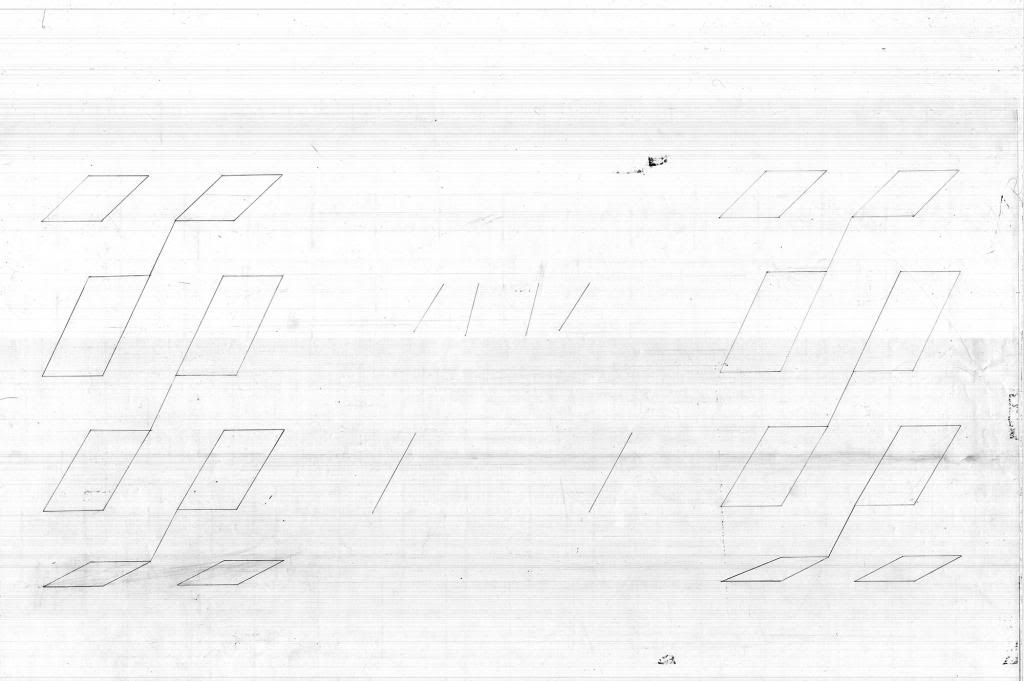
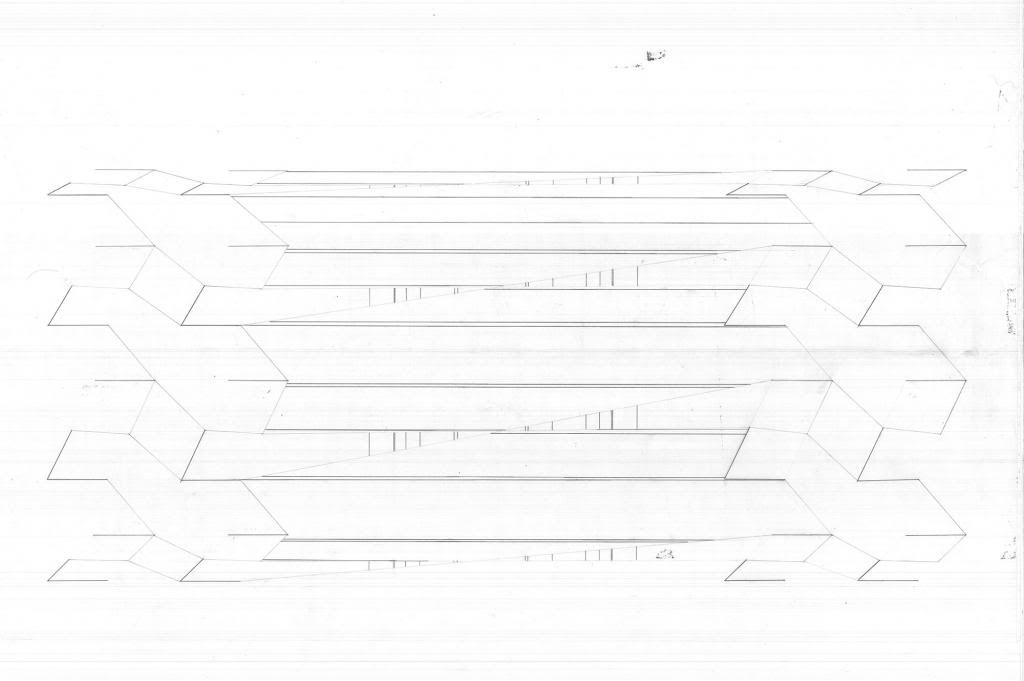
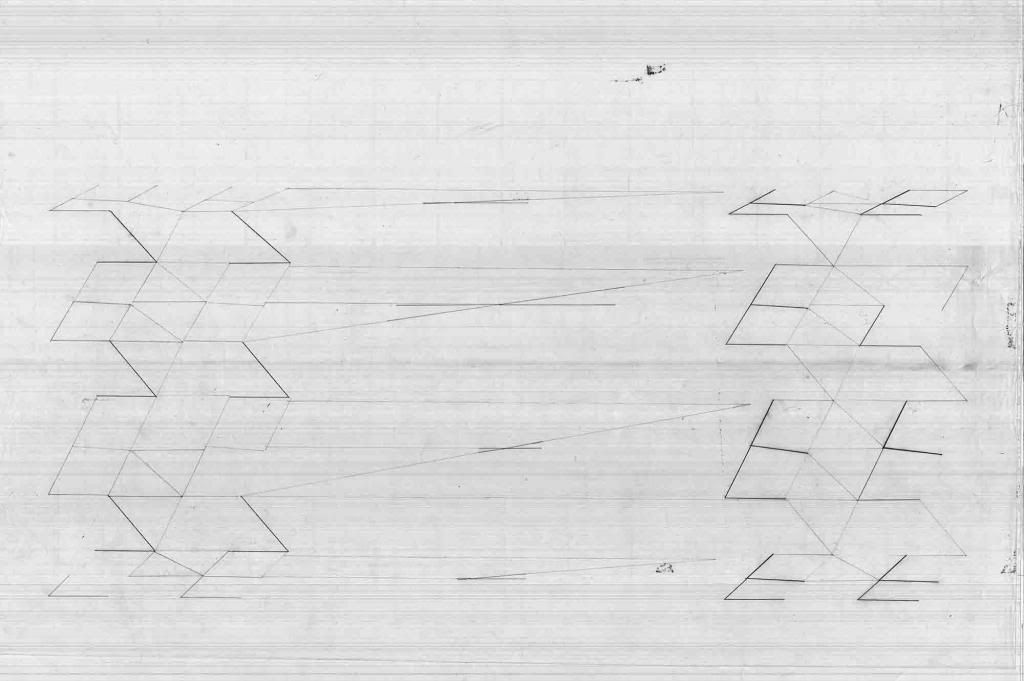
In the process of creating the 3D version of of my synthetic design combined with the townhouse elevation, I kept the same theme of using each opening as my boundary. From there, I drew lines from each frame across to the opposite end. I then placed my synthetic drawing on each side of the elevation and connected it. One set was laced closer to the top and the other was at the bottom. This created a slanted connection between the two mirroring planes. This was done because of the placement of windows and doors in the house were asymmetrical. The synthetic design was placed closer to where the windows and doors existing. Whatever exists more in mass or form prevails, which would mean that the set of windows on the left hand side would be closer to the synthetic set, while the the bottom portion would not be placed near a synthetic. The dynamic between the two synthetics were much like the idea of boundaries in that it was created by the frames of the window and the doors. This created two sets of direction: a horizontal and vertical force. The two sets of direction in turn creates this set of 3D Axon.


The curves in this model is entirely based off of the flat planes that created a surface, but did not complete into one whole solid. By creating the curve in the structure, there is a base point from where the original curved plane comes from. This allows for its existence. All solids are formed because it is surrounded by other planes. Once a plane has four or more sides, it is completely enclosed to form one solid.

Sunday, February 9, 2014

Cat's Cradle: Fred Sandback & Spatial Stories

Source: Cat's Cradle

1) In what way does cat's cradle create "a little place" as Sandback describes? Consider notions of space and place defined by de Certeau in "Spatial Stories."

I feel as if the “places” cat’s cradle creates is not a place, but more of a “space” based on De Certeau’s description of the distinction between space and place. In “Spatial Stories,” De Certeau emphasizes that a “place” is stagnant compared to a “space,” which is interchangeable at all times. Throughout the game, each player changes the space through different combinations, thus resulting in the creation of a whole new space. Because each space is entirely interchangeable, it is clear that it has created new space and not a new place. Through the act of manipulating the strings, space is consistently changed.

2) Experiment: Learn how to play cat's cradle if you don't already know. Practice playing cat's cradle in different environments and document the events in photographs or video. Post to your blog and explain--in a single sentence--the way that this small action involving string produces space (or in Sandback's terms, "a little place"). In what way does the site become part of the game? How does the game interact with a particular site, and a particular moment?

Through different environments, we feel challenged and uneasy, due to particular circumstances.

3) Experiment: In Sandback's "Remarks on my sculpture" he says that "Having these seven huge rooms to work in was a small revelation, in that I was able for the first time to see how these pieces acted together and to work with them simultaneously."  Experiment with using yarn to explore and analyze the circulation of space and the relationship in and between rooms--Run a continuous loop of yarn through the space of the room and notice how it must behave to link the spaces together. Run yarn between rooms to see how they relate--their flow, interruptions, shapes of movement.

I think the most interesting part of this assignment is the fact that it creates new space based on the existing space. The spatial relationship between the existing spaces is intriguing in the sense that it creates sub division of spaces and although each space is different, it is derived from the same material. Depending on its variation, this new space can be inviting or uninviting.


4) How does "play" function in Sandback's approach to his work and materials? Was play an element of your Sandback assignment? How does play function in your own design practices?

I think it’s important to incorporate “play” into work. Inspirations that result in the greater things in life rarely come from one’s static interpretations on what to do. Experimentations that derive from one’s static interpretation can be felt through the work. Similarly if one incorporates “play,” the result will have a sense of playfulness that can be felt by others. “Play” was definitely involved in our design in the sense that we go by our initial instincts. The resulting work is more natural because it is not overanalyzed. Although it is completely natural, under analyzed work is not perfect, either. This calls for a review of the work completed to “round off the edges” to perfection.

Journal Entry : #1

I believe the most significant moment of transformation occurred shortly after the inclusion of diagonal lines in the synthetic drawing set. The direct result of this was the formation of new geometrical shapes. Entirely unexpected, I had started from something that was more linear in the 90-degree and 180-degree spectrum and ended up with something with a sense of ordered playfulness. As this new diagonal element was introduced into my project, I exploited it and created new shapes. Although, I am not fond of the final outcome, I do find it intriguing that such a design can result from the combination of 90 and 180-degree lines with several diagonal lines.
In the translation process from 2D to 3D, I chose my 5th layer, as I did not like the result of my final layer. I decided on the 5th layer, because it displayed more of the process than my final layer. Through this layer, I had chosen several lines to outline in bold. Due to this decision, I created an interesting 3D effect on the 2D drawing. Although this is not shown too well on my rhino drawing, I like the effect that it has on paper and will further include it in my future design. I like the idea of how hierarchy can play a role in the creation of different space.


Monday, February 3, 2014

Synthetic Drawings: Design Based on (Back) Elevation of Townhouse


Rule Sets from Various Artists

Anthony Mccall and his Line Describing a Cone has an interesting system. A beam of light is emitted out of a film projector at one end of a dark room. Projecting on the screen is an animated film of a small thin arching line that creates one complete circle as it traces the outline of the circumference of a circle. Viewers are told to stand in front of this interactive art. As the viewer’s body blocks the light, the circle that appears on the screen appear to be either a concave or convex. I think interesting about this system is that it is interactive. In a sense that the outcome is created by different situations, yet the rules are the same. I chose this piece because its something simple yet thought provoking. It’s not something that people would think of as a rule, but it is at the same time. 

Source: http://images.artnet.com/artwork_images_168878_633101_anthony-mccall.jpg

In Richard Serra’s Gagosian Gallery, the art piece Cycle draws upon a different kind of system from many other artists. Serra is known for his minimalist work and in the Cycle, it’s obvious that it is a very minimalistic piece. Although there is not much to the art piece, it is obvious what Serra is trying to convey. In the swirls that he creates, he has each swirl facing the next swirl. This creates a pinwheel effect, in which the art piece seems to be swirling in one direction. This effect is emphasized by the second ring of swirls around the first set of swirls. This site-specific art acts as spatial division, as well as circulation dictation. This is also the very reason why I chose this piece. The rules for this art piece forces the viewers to act in one direction in unison with the art piece itself. 

Source: http://www.m-kos.net/wp-content/uploads/SERRA_2011_Cycle2_580.jpg

Oskar Schlemmer’s piece the drawing of a Man as Dancer, really depicts rules in a conventional way that is graceful and interesting. In the center of the art piece, there is a man in a dancing pose. In the center of his chest, circles emit out from his chest. They echo out of the page. Although, a simplistic design, the best part of the piece are the ovals that cast out from the man. An example of this would be the oval over his head connecting to his two hands. This oval overlaps with the ovals that are created from his legs. In this manner, Schlemmer continues to use this man’s body parts as extensions for the ovals. All the ovals overlap, it creates a different art piece with flow and movement in an elegant matter. I thought the rules for this piece was interesting because it is created from such simple decisions, yet it becomes so much of the whole of the art piece.

Source: http://media.tumblr.com/tumblr_mez9bfOaSl1qmktfq.png

Pratt Townhouses: Elevation Studies


Site Research: Falling Water


Saturday, February 1, 2014

Art, Architecture, and English

Fred Sandback illustrates the use of spatial exploration through the experimentation of yarn. By stretching yarn across the room from various locations, he is able to successfully redesign a space. Based on his work in the David Zwirner Gallery, one can speculate the spatial explorations Sandback aims to reveal. An example of such exploration would be the stretching of yarn across the diagonal of a white room. The room has three separate doorways, in which, the viewers first enter from the left side of the room. Two exits are located on the same side directly to the viewers left hand side. Due to the placement of this yarn, which basically divides the room, visitors decide to enter through the first exit on the left instead of the exit on the further left hand side. This is mostly because of the yarn. As it is stretched diagonally across the room, it divides the space in a way that prevents most people that are standing erect, from passing through.


Source: http://www.davidzwirner.com/wp-content/uploads/2011/12/16-Variations-and-Mikado-600x450.jpg


In our own attempt to work with space in Sandback's style, we chose a room and implemented the use of string in place of yarn. We were able to recreate Sandback's spatial exploration by using strings to divide a room. In this room, we stretched out the string at a height that only certain people are able to pass through. Through this experimentation we were able to understand how circulation works in the use of spatial division. Depending on how string/yarn is stretched in spatial divisions, the area is completely redesigned. These string-obstacles become some sort of surface that acts just as well as a barrier or furniture. Ironically, strings and yarns are thin and the walls they create are not at all impenetrable, yet, the space they occupy and the extent they stretch out to are almost seen as an impassable force.